
Contractor management has two meanings, and search results mix them constantly. In this guide, the term refers to the HR and workforce sense — how a company hires, classifies, onboards, pays, and offboards independent contractors — not the industrial or site-safety sense (managing on-site contractors' health-and-safety compliance) that many construction and EHS pages describe. If you landed here looking for safety prequalification or procurement, this is not that page.
Everything below is written for teams that engage contractors across borders: a designer in Brazil, an engineer in Germany, a marketer in France, all on the payroll of a company that may sit in an entirely different country. That global lens matters. The hard parts of the job — classification rules, currency, local tax forms — are exactly the parts that change the moment a worker sits outside your home market.
Last updated August 6, 2026. Jump to: What is contractor management? · What the software must do · Best contractor management software
First the definition and workflow, then the software. If you already know you need a platform and are past the definitions, jump straight to what contractor management software must do or the comparison table. See how Remote& runs contractor management if you want the product view first.
What is contractor management?
Contractor management is the process of sourcing, classifying, onboarding, paying, and offboarding independent contractors in a compliant, organized way. For global teams it also covers cross-border payments, local tax paperwork, and the worker-classification rules that change from one country to the next — so a contractor in Brazil is handled as correctly as one in Germany.
That is the short contractor management definition. The longer answer: it spans two jobs at once. One is operational — getting people hired and paid on time. The other is compliance — keeping each engagement legally sound where the work happens. A freelancer platform handles the first. A payroll tool handles part of the second. Real tooling ties both to one record per worker.
Different teams stress different parts. Finance cares about paying the right amount, on time, with an audit trail. People-ops cares about fast onboarding and current contracts. Both are right.
What contractor management covers
Across most global teams, contractor management follows the same lifecycle, adapted for cross-border work:
- Sourcing and classification — decide whether the person is genuinely a contractor or should be an employee, before any contract is signed.
- Onboarding and agreements — issue a localized, country-specific contract; collect tax and identity documents; set up the payment method.
- Payments and compliance — approve invoices, pay in the worker's currency, and keep local tax and reporting obligations met.
- Performance — track deliverables, renewals, and rate changes across the engagement.
- Offboarding — close out final invoices and keep records for the retention period each country requires.
Most contractor management systems automate stages two and three, where the repetitive, error-prone work lives. The riskiest stages — classification at the start and final settlement at the end — are where global teams most often need real contractor management services, not just software, because the rules are local and unforgiving.

Worker classification and misclassification risk
Misclassification is the single most expensive mistake in this whole process. It happens when someone is engaged as a contractor but the working relationship looks, legally, like employment. Watch for these red flags:
- Control — you set fixed hours, dictate exactly how the work is done, or require the person to work only for you.
- Integration — the contractor does the same core work as your employees, indefinitely, with no defined project or end date.
- Economic dependence — the person relies on you for substantially all of their income and uses your equipment and systems to do the job.
These red flags draw on the common legal tests for employment status — notably the IRS right-to-control rules in the US, which turn on whether the hirer controls how the work is done, not just the result, and similar economic-reality tests elsewhere (source).

Get it wrong and the bill arrives as back taxes, unpaid benefits, social contributions, and penalties — sometimes years later, in a currency you were not tracking. That is why contractor compliance is core, not an afterthought. Remote& is designed to reduce this exposure with built-in misclassification protection and a Contractor of Record option that shifts classification liability off your books. For the full picture, read the full misclassification guide.
Paying contractors across borders
Cross-border payment is where domestic and global contractor management genuinely diverge. A contractor in Germany may invoice in euros and expect a SEPA transfer; one in Japan may need a local rail; one in the US expects direct ACH; one in Brazil may prefer a stablecoin payout to avoid FX drag. Each also comes with its own tax forms and reporting thresholds.
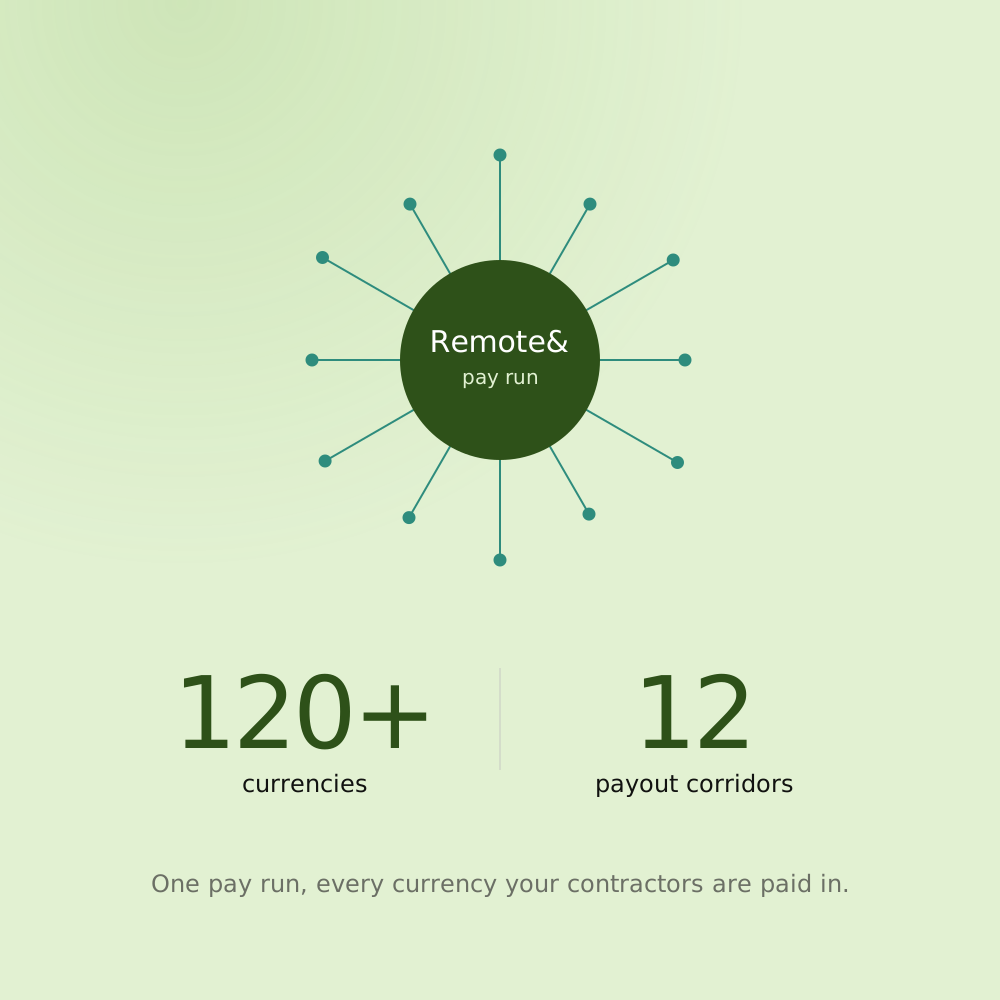
Doing this well means paying in local currency, choosing the right payment corridor, and generating the right documentation per country — ideally from one pay run rather than five bank portals. Remote&, for example, runs 120+ currencies across 12 payout corridors so contractors, EOR employees, and direct hires are paid together (source). For the mechanics, see how to pay international contractors.
Contractor management vs. contractor management software
The process is one thing; the software is the tool that runs it. The process exists whether or not you buy anything — a five-person startup can manage contractors with a spreadsheet and a bank login. Software earns its place when the manual version starts leaking: missed tax forms, duplicate payments, stale contracts, undocumented classification calls.
So what is contractor management software? It is a platform that centralizes contracts, payments, compliance records, and reporting for your contractor workforce, usually with automation for the repetitive stages and guardrails for the risky ones. The rest of this guide compares the leading options.
What contractor management software must do
Before comparing brand names, it helps to know what the category is supposed to solve. If a tool is missing any of the five items below, it is not enough on its own for a team hiring contractors across borders — no matter how polished the dashboard looks.
- Classification support. The tool should flag control, integration, and economic-dependence risk at the point of hire, not after a dispute starts. See the contractor misclassification guide for the specific red flags a platform should be checking for.
- Localized contracts. Country-specific agreement templates, not one translated template reused everywhere. A proper international contractor agreement needs clauses that hold up under the laws where the contractor actually works, not just where you're based.
- Multi-currency payouts. Contractors get paid in their own currency, through a corridor that actually reaches their bank or wallet without excessive FX drag. How to pay international contractors covers the mechanics and the corridor choices that matter.
- Tax documentation. Country-appropriate tax forms — W-9/W-8BEN-equivalents and local invoicing requirements — collected and stored per worker, generated automatically instead of chased by email at year-end.
- Audit trail. A timestamped record of who approved which payment, which contract version is currently live, and when classification was last reviewed. This is what makes a dispute or a tax audit defensible, and it's the first thing a spreadsheet-based process usually lacks.
Treat this as the floor, not the differentiator — most vendors in this category claim all five. The real test is whether the claim holds up on the vendor's own pricing and product pages, which is exactly what we checked for the comparison below.
Contractor management vs. employer of record
These two get confused because both let you engage global talent without opening a local entity. The difference is who employs the worker.
The contractor stays an independent contractor — self-employed, invoicing you, responsible for their own taxes. With an employer of record (EOR), a third party legally employs the worker on your behalf, so the person is a full employee with a payslip, benefits, and statutory protections. Read what an employer of record is for the full comparison.
There is also a middle path. A Contractor of Record keeps the person working as a contractor but places a compliant intermediary between you and the classification risk — see what is a contractor of record for the full definition and how it differs from an agent of record. Remote& offers all three on a single worker record, so switching lanes does not mean switching systems (source). This is why employer of record for independent contractors and contractor of record vs employer of record are worth weighing before you sign anyone — the right structure depends on control, duration, and risk.

Contractor management best practices
A short checklist that holds up across markets:
- Classify before you contract. Run the control, integration, and dependence tests up front, and document the decision.
- Localize every agreement. Use country-specific templates, not a translated US template — the clauses that matter differ by jurisdiction.
- Separate who prepares pay from who approves it. Segregation of duties catches errors and fraud before money moves.
- Screen invoices. Watch for duplicates, off-pattern amounts, and changed bank details before payment, not after.
- Keep records for the local retention period. Contracts, tax forms, and settlement records outlive the engagement.
- Review classification on renewal. A project can quietly drift into de facto employment over time.
Should you outsource contractor management?
There are three honest options, and the right one depends on scale and risk tolerance.
Do it in-house with spreadsheets and your bank when you have a handful of contractors in one or two countries. Buy software when volume, currencies, or compliance overhead start costing you real time and mistakes. Use full-service — a contractor management company or an EOR/Contractor-of-Record provider — when the classification and payment risk is high enough that you want someone else's compliance infrastructure carrying it.
Most growing teams blend the last two: outsourced contractor management for the risky engagements, self-serve software for the rest. The comparison below is for teams at that stage.
Best contractor management software in 2026
This is our shortlist of the best independent contractor management software for teams that hire and pay contractors across borders — not for managing on-site construction or field crews, which is a different software category entirely. Every tool here is a genuine global-workforce platform. We looked at entity model, country and currency coverage, pricing transparency, and independent review signal. If you only manage domestic contractors, most still work — you are just paying for global capability you may not use.
Disclosure. Remote& publishes this comparison, is one of the tools included, and is listed first. We think that is fair to say out loud. Every competitor claim below is sourced to a public page — the vendor's own pricing or product page, or its G2 profile — and dated. Ratings, prices, and coverage figures were last checked 2026-07-17 and change often; verify current figures before you buy. We do not list invented weaknesses; "considerations" reflect public information only.
How we evaluated these tools
We scored every platform against the same five capabilities from the section above, then checked the claim against the vendor's own public pages. Specifically:
- Published pricing — what the vendor states on its own site, not a quote given to us privately, dated to the day we read it.
- Entity model — whether the platform offers contractor-only, Contractor of Record, EOR, or a mix, as stated by the vendor.
- Country and currency coverage — the figures the vendor itself publishes, not our estimate.
- Compliance features — whether classification screening and misclassification protection are included or sold as an add-on.
- Independent review signal — G2 rating and review count, read directly from the product's G2 profile.
We did not weight Remote&'s own entry more favorably than the criteria above, and we did not score anything we could not verify on a public page — where a vendor doesn't publish a figure, the table below says so instead of guessing. Methodology last reviewed August 6, 2026; the dated price and rating checks throughout this section were performed July 17, 2026 and are called out inline.
At-a-glance comparison
| Tool | Entity model | Global coverage | Starting price (per contractor/mo) | G2 rating (checked 2026-07-17) | Best-fit team |
|---|---|---|---|---|---|
| Remote& | Contractor + EOR + Contractor of Record on one record | 120+ currencies, 12 payout corridors | Free trial; custom pricing | Not yet rated on G2 | Teams mixing engagement types on one worker record |
| Deel | Contractor, Contractor of Record, EOR | 150+ countries, 150+ currencies | $49 | 4.7 / 5 (6,838) | Teams wanting the widest country footprint |
| Remote (Remote.com) | Contractor, Contractor of Record, EOR | 200+ countries, 70+ currencies | $29 | 4.5 / 5 (4,467) | Teams wanting productized compliance tiers |
| Oyster | Contractor, EOR | 180+ countries, 120+ currencies | $29 (after 30-day free) | 4.4 / 5 (1,543) | Values-driven teams (Oyster is a B Corp) |
| Globalization Partners (G-P) | Contractor, EOR | 190+ countries, local-currency payouts | $39 | 4.4 / 5 (1,043) | Enterprise and global teams |
Prices and ratings above are sourced in each write-up below. Want a recommendation for your specific mix of countries and headcount? Talk to us about your contractor workforce.
1. Remote&
Remote& is an AI-native People OS built around one idea: a contractor, an EOR employee, and a de-risked Contractor of Record all live on the same worker record and are paid from the same pay run. That unified model is the differentiator — no separate system for contractors and employees, and no data migration when an engagement changes lane (source).
What it is built for:
- One worker record across contractor, EOR, and Contractor of Record. Mix engagement types on a single team without switching tools.
- One pay run, many corridors. Contractors, EOR employees, and direct hires are paid together across 120+ currencies and 12 payout corridors, with separation of duties enforced between preparation and approval.
- AI invoice screening. Remi, the built-in agent, scans every invoice before payment and flags duplicate submissions, off-pattern amounts, and changed bank details.
- Misclassification protection and localized contracts. Country-specific templates and built-in classification safeguards, with statutory logic computed per market rather than bolted on.
Why we rank ourselves first, honestly: this is our list, and the unified-record model is the strongest fit for teams that mix contractors and employees globally. Read the competitor entries and decide for yourself — that is the point of a disclosed comparison. Remote& is newer than the incumbents below and does not yet carry their volume of G2 reviews, a fair thing to weigh. See it run through the global workforce management platform.
2. Deel
Deel is the breadth leader in this category. It supports contractors, Contractor of Record, and EOR employment across 150+ countries and 150+ currencies (checked 2026-07-17), which is among the widest published footprints available (source). It also carries by far the largest independent review base in the category: a G2 rating of 4.7 out of 5 from 6,838 reviews (source).
Public pricing, as of 2026-07-17: its contractor plan starts at $49 per contractor per month, Contractor of Record at $325 per contractor per month, and EOR at $599 per employee per month (source).
Consideration: Deel is a very broad platform spanning payroll, HR, IT, and more. That breadth is a strength if you want one vendor for everything, and something to scope carefully if you only need contractor tooling, since add-ons and country surcharges can layer onto the headline rate.
3. Remote (Remote.com)
Name-collision note: Remote (at remote.com) is a different company from Remote& (this site, at remoteand.com). Same first word, unrelated products — worth stating so neither you nor a search engine conflates the two.
Remote.com's strength is productized compliance. It covers 200+ countries and jurisdictions and pays contractors in 70+ currencies (checked 2026-07-17), with localized agreements and built-in misclassification risk detection (source). Its Contractor Management Plus tier adds indemnity protection the vendor states as up to $1 million (with $100,000 per contractor for penalties), and its Contractor of Record option carries uncapped indemnity, backed by a compliance-monitoring service the company calls Remote Watchtower (source). On G2 it holds 4.5 out of 5 from 4,467 reviews (source).
Public pricing, as of 2026-07-17: $29 per contractor per month for Contractor Management, $99 for Contractor Management Plus, and from $325 for Contractor of Record (source).
Consideration: currency coverage (70+) is narrower than some rivals, so check that your contractors' currencies are supported.
4. Oyster
Oyster is a global-employment platform and a certified B Corp, which appeals to values-driven teams. It supports contractors and EOR employees across 180+ countries with payments in 120+ currencies (checked 2026-07-17), and consolidates contracts, invoices, tax forms, and reporting into one interface (source). On G2 it holds 4.4 out of 5 from 1,543 reviews (source).
Public pricing, as of 2026-07-17: global contractors are free for 30 days, then $29 per contractor per month, with an optional "Oyster Shell" misclassification-protection add-on (aggregate coverage the vendor states up to $500,000) and EOR from $699 per employee per month (source).
Consideration: misclassification protection is a paid add-on rather than included in the base contractor plan, so factor it in if classification risk is a concern.
5. Globalization Partners (G-P)
Globalization Partners (G-P) is an enterprise-focused global-employment platform. Its contractor product, G-P Contractor, lets you hire, classify, and pay contractors in their local currency across 190+ countries, with invoice generation and approval built in (checked 2026-07-17) (source). Compliance is a highlight: it flags and updates non-compliant contractor agreements using what the company describes as a purpose-built global classification model — misclassification protection built into the workflow (source). On G2 it holds 4.4 out of 5 from 1,043 reviews (source).
Public pricing, as of 2026-07-17: G-P Contractor starts at $39 per contractor per month — one of the few transparent, published per-contractor prices in the enterprise tier (source).
Consideration: G-P is enterprise-oriented, and its core EOR offering is quote-based rather than a published rate — the transparent $39 applies to the contractor product, so scope the EOR side with sales if you need it.
Other tools you may see mentioned
Category-adjacent products come up in research without being global-contractor-first. Rippling bundles contractor payments into a broad HR/IT/finance suite. You may also encounter platforms like Native Teams and RemotePass in this category. We have not run full entries for these; treat them as names to shortlist, not verified recommendations.
How to choose contractor management software
Contractor management solutions vary widely, so score any shortlist against five factors — these are the buying-committee version of the five must-haves above:
- Global coverage — do they support every country and currency your contractors actually sit in, not just the headline count?
- Compliance support — is misclassification protection included or an add-on, and do they offer a Contractor of Record path for risky engagements?
- Pricing transparency — is per-contractor pricing published, and does it hold once add-ons and country surcharges are included?
- Integrations and record model — does contractor data live alongside your employee data, or in a silo you will later have to reconcile?
- Audit trail and reporting — can you reconstruct who approved a payment or contract change, and when, without opening a support ticket? Ask for a sample export before you buy, not after your first audit.
If your team blends contractors with employees, weight the record model heavily — a unified worker record is the difference between one source of truth and a reconciliation project. If you are still deciding between contractor and employee structures, EOR vs. a staffing agency and freelancer vs. contractor are useful next reads. And when a contractor relationship outgrows itself, here is how to convert a contractor to an employee.
Frequently asked questions
What does contractor management mean?
Contractor management means hiring, classifying, onboarding, paying, and offboarding independent contractors compliantly. For global teams it also covers cross-border payments, local tax forms, and country-specific classification rules. It is distinct from the industrial or site-safety use of the term (managing on-site contractors' health-and-safety compliance).
What's the difference between contractor management and contractor management software?
One is the process; the other is the platform that runs it. You can manage a few contractors with a spreadsheet and a bank account. Software earns its place once volume, currencies, or compliance obligations make the manual version slow and error-prone.
How does remote and global contractor management work?
Remote contractor management and global contractor management handle workers in different countries from yours. In practice that means localized contracts, classification under local rules, payment in local currency through the right corridor, and correct tax documentation per country — ideally from one pay run.
Is contractor management software the same as an employer of record?
No. The first keeps the person an independent contractor who invoices you and handles their own taxes. An employer of record (EOR) legally employs the worker for you — a full employee with benefits and statutory protections. A Contractor of Record sits between: an employer of record for independent contractors option that keeps the contractor relationship while an intermediary carries the classification risk. The contractor of record vs employer of record choice: employment, or a de-risked engagement.
Should you outsource contractor management or handle it in-house?
Handle it in-house when you have a few contractors in one or two countries. Buy software when volume, currencies, or compliance overhead start costing real time. Choose outsourced contractor management — a full-service provider or EOR — when classification and payment risk is high enough to hand someone else's compliance infrastructure the load. Many teams blend both: full-service for risky engagements, self-serve for the rest.
How much does contractor management software cost?
Published per-contractor pricing currently ranges from roughly $29 to $49 per contractor per month for a standard plan, with Contractor of Record options from about $325 and misclassification add-ons priced separately (as of 2026-07-17; sources above). Real cost depends on countries, currencies, and add-ons — model it with a contractor cost calculator, and if you are weighing employment, the employer of record cost.
Can contractor management software help prevent misclassification?
Yes, to a degree. Good platforms flag classification risk at onboarding, keep localized contracts current, and offer a Contractor of Record path that shifts classification liability to a third party. But software cannot remove the need to classify correctly. See the full misclassification guide for the red flags.
What features should contractor management software have?
Look for localized, country-specific contract templates; classification safeguards; multi-currency payments through solid corridors; tax documentation per country; invoice screening; and a record model that keeps contractor data beside employee data. For global teams, the ability to move between contractor, Contractor of Record, and EOR without switching systems signals a mature platform.
What is an audit trail in contractor management software, and why does it matter?
An audit trail is a timestamped record of who approved each payment, which contract version is live, and when a worker's classification was last reviewed. It matters because it is what makes a tax audit or a misclassification dispute defensible years later. Ask any vendor for a sample export before you buy, not after you need one.
Does contractor management software support multi-currency payouts?
The better platforms do, paying each contractor in their own currency through a local corridor rather than a single default currency with a conversion fee tacked on. Coverage varies a lot by vendor, from around 70 currencies up to 150 or more, so check that your contractors' actual currencies are included before you commit. See how to pay international contractors for the corridor-level detail.